California Solar Street Lights: Why HOAs and Developers Are Ditching the Utility Pole
Why California communities are moving from utility-owned street lighting to off-grid solar LED systems — costs, HOA math, and what to look for in 2026.
California gets more usable sun than almost any other state in the country — and yet most of its neighborhoods are still lit by the same utility-owned fixtures that have been bolted to the same poles since the Reagan administration. That gap between "we have the sun" and "we're still paying the utility by the month" is exactly where solar street lighting has quietly become one of the fastest-growing line items in HOA budgets and new development plans across the state.
This isn't a future-tech story. It's a math story.
The Real Problem: HOAs Are Paying Rent on Light They Could Own
Most California HOAs don't own their street lighting — they lease it, indirectly, through a monthly utility line item that never goes away and rarely gets cheaper. The fixtures are often 30-40 years old, the light quality is poor by modern standards, and any request for an upgrade usually comes with a new 5- or 10-year contract at a higher rate.
Three things make this worse in California specifically:
and they've been climbing faster than inflation for over a decade.
get passed down to ratepayers, including HOAs paying for streetlight power.
can stretch a simple lighting upgrade into a multi-year utility project.
A solar street light sidesteps all three. There's no trench, no utility interconnection application, no dependency on grid stability during a Public Safety Power Shutoff (PSPS) event — which matters a lot when your neighborhood's only streetlight goes dark on exactly the nights wildfire risk is highest.
Why Solar Actually Works Here (Not Just “Because Sunshine”)
California's solar case isn't just about total sunlight — it's about reliable daily sun exposure across most of the state, low cloud cover for most of the year, and a regulatory environment (Title 24, dark-sky ordinances in several counties) that already nudges developers toward efficient, controllable lighting. Off-grid solar fixtures with motion-sensor dimming check both boxes at once: they're compliant by design, and they don't need a grid connection to prove it.
The other underrated factor: California's dark-sky and coastal lighting ordinances (common in places like Malibu, coastal San Diego County, and parts of the Central Coast) increasingly favor fixtures that dim automatically and avoid uplight — something a modern solar LED with motion detection handles natively, versus retrofitting an old cobra-head utility fixture.
Matching the Light to the Project
Not every California project needs the same fixture, and this is where a lot of HOAs overspend or underspec:
Residential streets and cul-de-sacs
Lower lumen output (roughly 7,000-8,000 lumen class) is usually sufficient and keeps costs down across a large pole count.
Collector roads, HOA entries, and parking lots
Mid-tier output (14,000-15,000 lumen class) balances coverage and battery size.
Highways, large commercial lots, and industrial sites
High-output fixtures (22,000+ lumen class) with expansion panel options for cloudy-week autonomy.
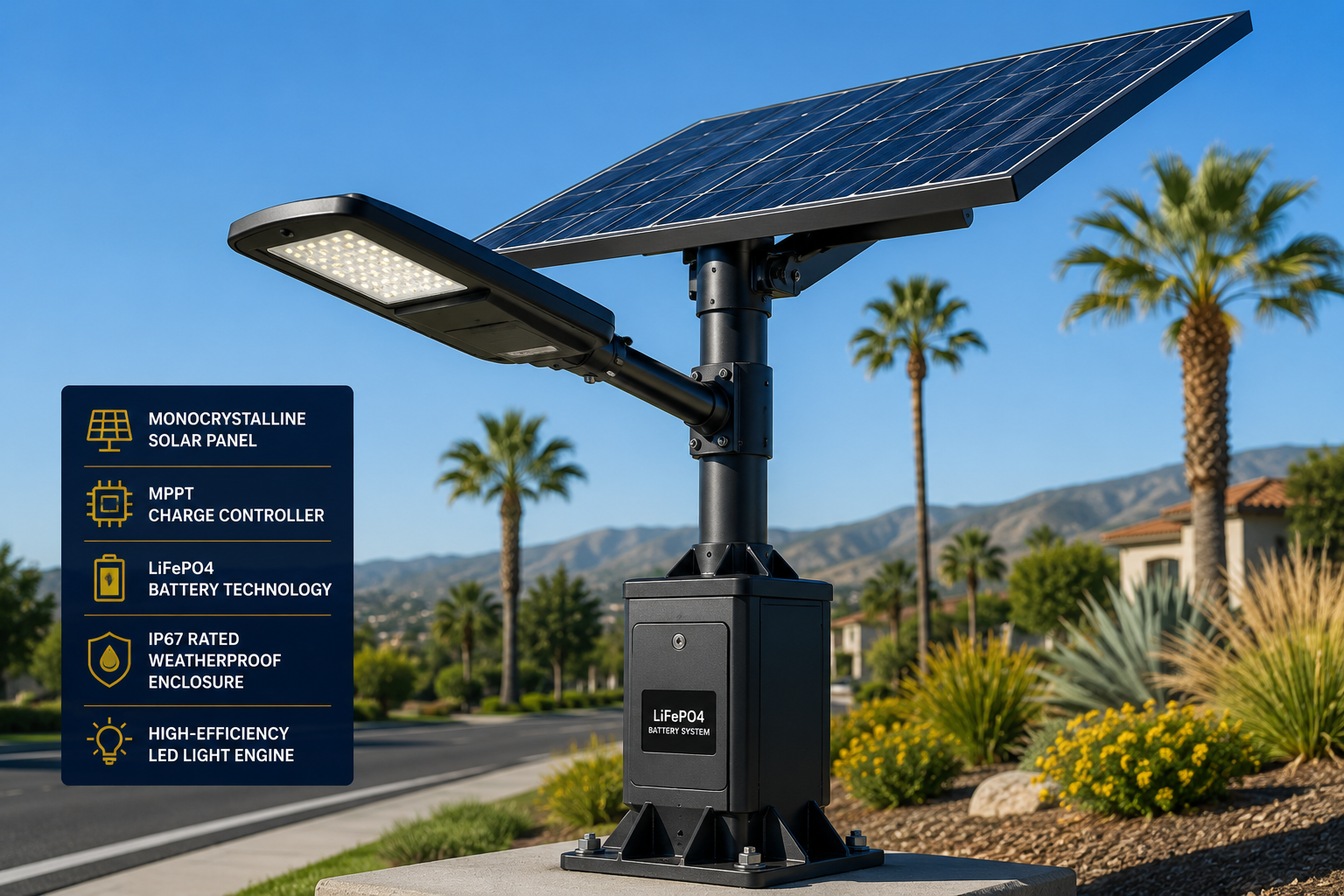
The detail most vendors gloss over: battery chemistry. LiFePO4 (lithium iron phosphate) batteries handle California's heat far better than older lead-acid or standard lithium setups — less degradation in high ambient temperatures, longer cycle life, and a safer thermal profile, which matters more in inland valley heat than most buyers realize until year three of ownership.
What This Looks Like in Practice
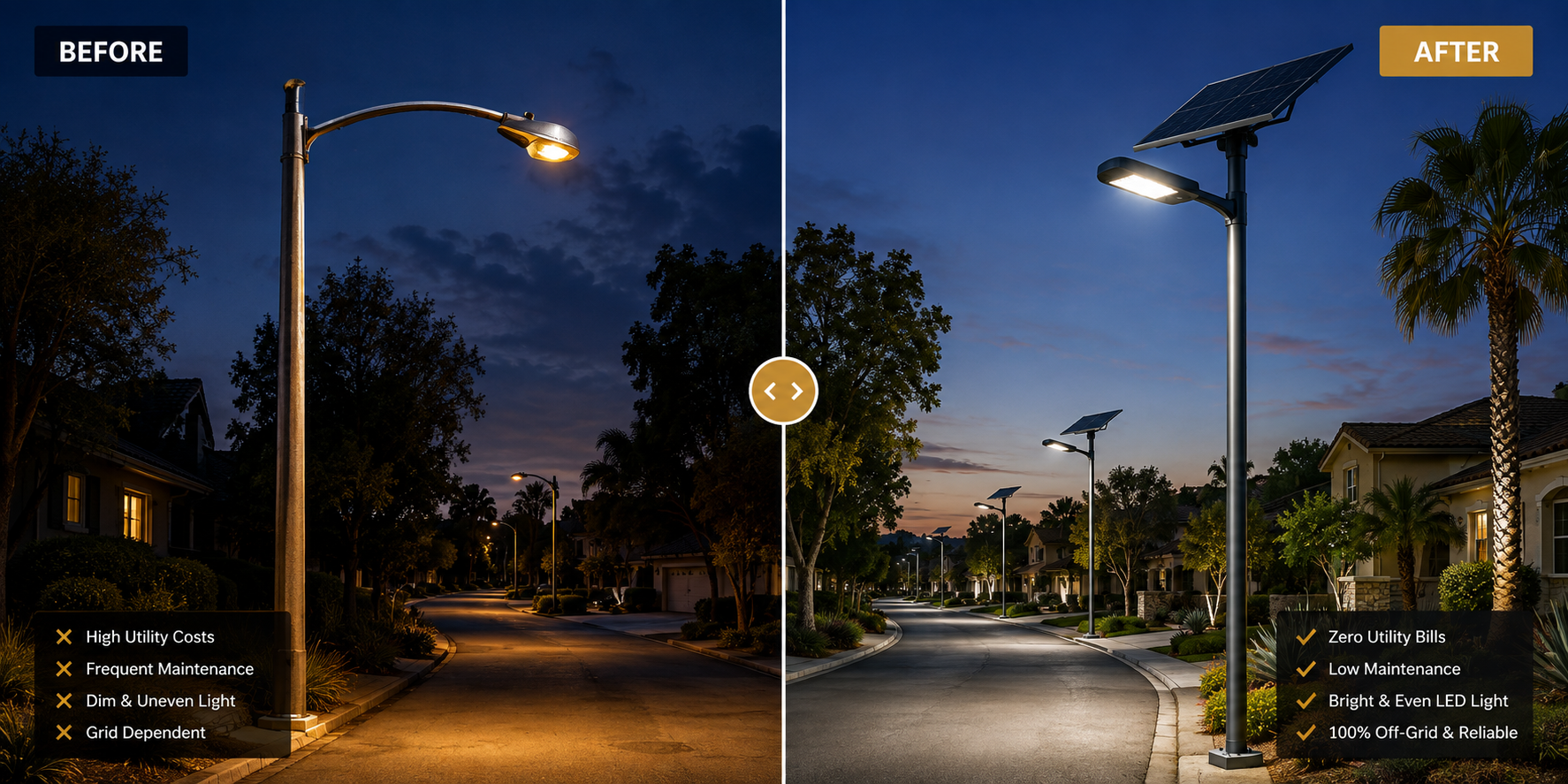
A mid-size HOA converting from utility-owned lighting to owned solar fixtures typically sees the payback story play out over three phases: elimination of the monthly utility lighting charge, a fixed one-time (or financed) install cost, and then 15-20+ years of near-zero operating cost outside of occasional battery replacement. Developers building new communities skip the utility relationship entirely — no trenching, no transformer coordination, no waiting on interconnection approval before a project can get its certificate of occupancy.
Manufactured home communities and mobile home parks have followed a similar path, often qualifying for federal tax incentives on the solar equipment portion of the install, which shortens the payback timeline further.
 BEFORE
AFTER
BEFORE
AFTER
FAQ: California Solar Street Lighting
Yes. Well-designed systems are sized with enough battery autonomy (typically 3-5 cloudy days) to carry through winter storm stretches, and panels are angled for optimal winter sun angle capture.
Most quality LED solar fixtures use full-cutoff optics and motion-based dimming, which meets or exceeds most California dark-sky ordinance requirements — worth confirming per-county before installation.
LiFePO4 batteries in a well-engineered system typically run 8-10+ years before needing replacement, significantly outperforming older battery chemistries in California's heat.
Over a 15-20 year horizon, yes for most HOAs and developments — the breakeven point depends on local utility rates and pole count, but eliminating a recurring monthly charge in favor of a one-time or financed cost is the core of the math.
The Bottom Line
California isn't a "someday" market for solar street lighting — the utility cost curve, wildfire-driven grid instability, and dark-sky regulatory pressure are already pushing HOAs and developers toward it. The communities making the switch now are locking in 20-year lighting costs at today's install price, while their neighbors keep paying an unpredictable monthly bill for the same old cobra-head fixture.