Florida Solar Street Lighting:
Built for Hurricane Season,
Not Just Sunshine
Florida's storm exposure and grid vulnerability make hurricane-resistant solar street lighting a practical infrastructure choice, not just a green upgrade. Here's what to know.
The Actual Problem: Grid-Dependent Lighting Fails at the Worst Possible Time
A utility-powered streetlight is only as reliable as the grid feeding it. In Florida, that grid gets tested every hurricane season — and when it fails, it tends to fail exactly where lighting matters most: evacuation routes, coastal roads, HOA entries, and parking lots that need to stay lit for safety and security during and after a storm.
Off-grid solar lighting isn't connected to that failure point at all. A properly engineered system keeps running through a grid outage because it was never depending on the grid in the first place — it's storing its own power and distributing it locally, storm or no storm.
That single fact is why solar lighting shows up so often in Florida's post-hurricane infrastructure conversations: it's one of the few pieces of a community's lighting system that doesn't need utility restoration to function again.
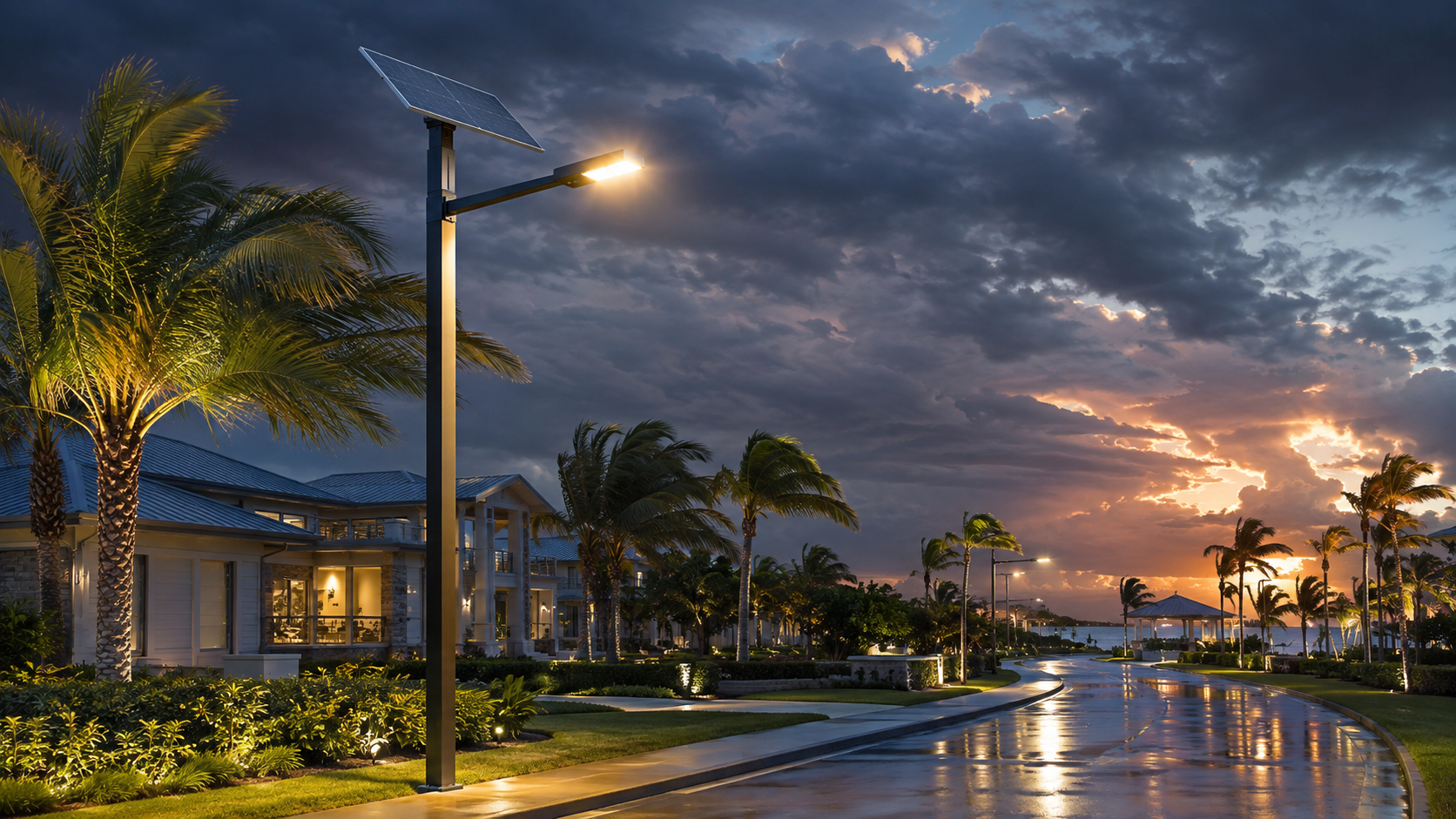
RESILIENCE
Lighting that doesn't
wait for grid restoration.
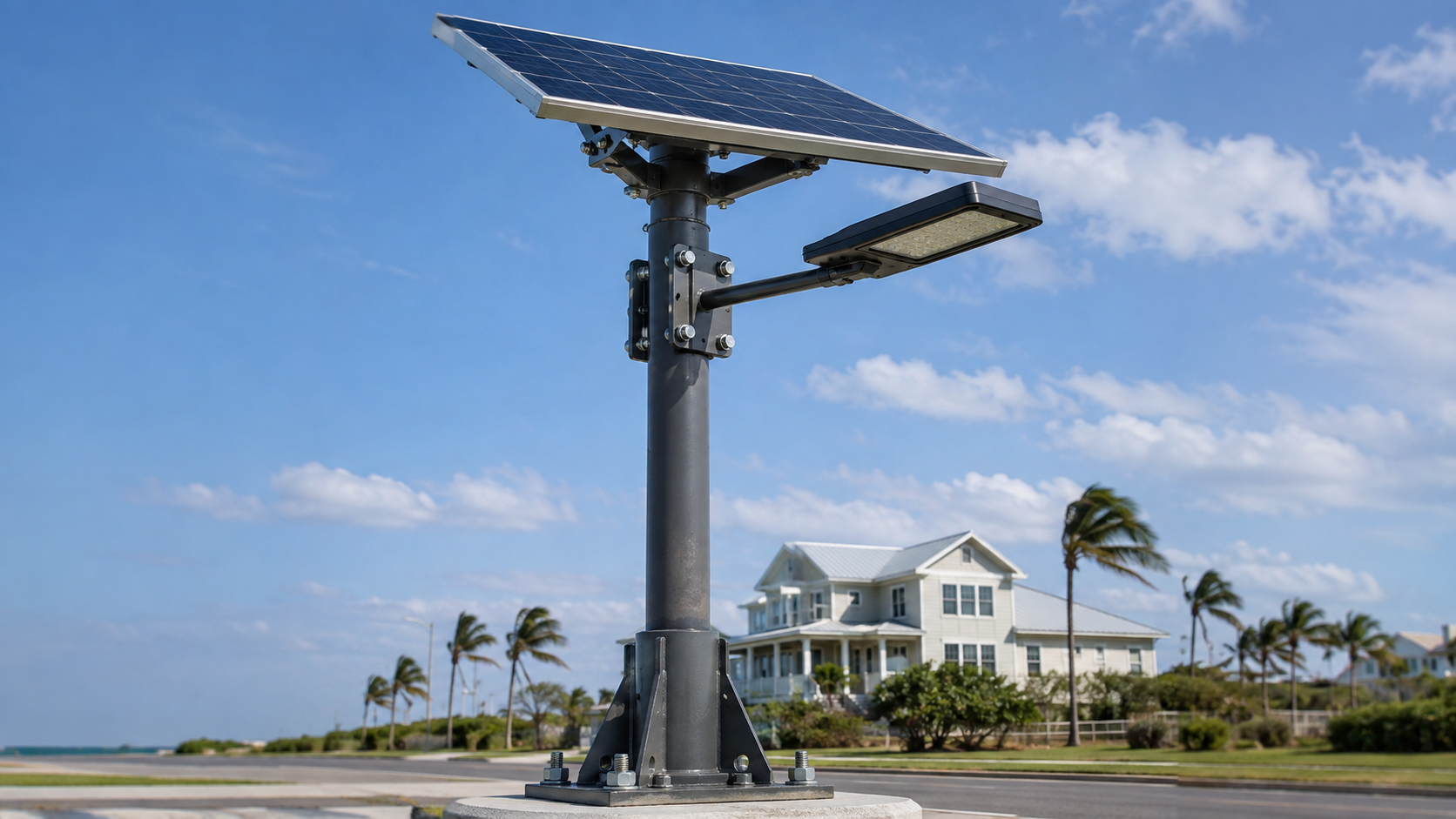
ENGINEERED Certified for
170 MPH winds
What "Hurricane-Resistant" Actually Means in a Spec Sheet
Not every solar light sold as "Florida-ready" actually is. The meaningful differences are:
— engineered for Florida's building code wind zones, not just a generic outdoor rating.
— galvanized steel and marine-grade fasteners matter enormously in coastal salt air, where standard hardware can degrade within a few years.
— panels need to survive sustained high winds and wind-driven debris, not just look sturdy in a product photo.
— battery compartments need to handle both heat and moisture intrusion, since Florida delivers both in abundance.
Buyers who skip this due diligence often end up replacing "solar-rated" fixtures after the first serious storm season — the cost difference between a genuinely hurricane-rated system and a standard one is usually smaller than the cost of doing it twice.
Where This Matters Most: HOAs, Resorts, and Coastal Municipalities
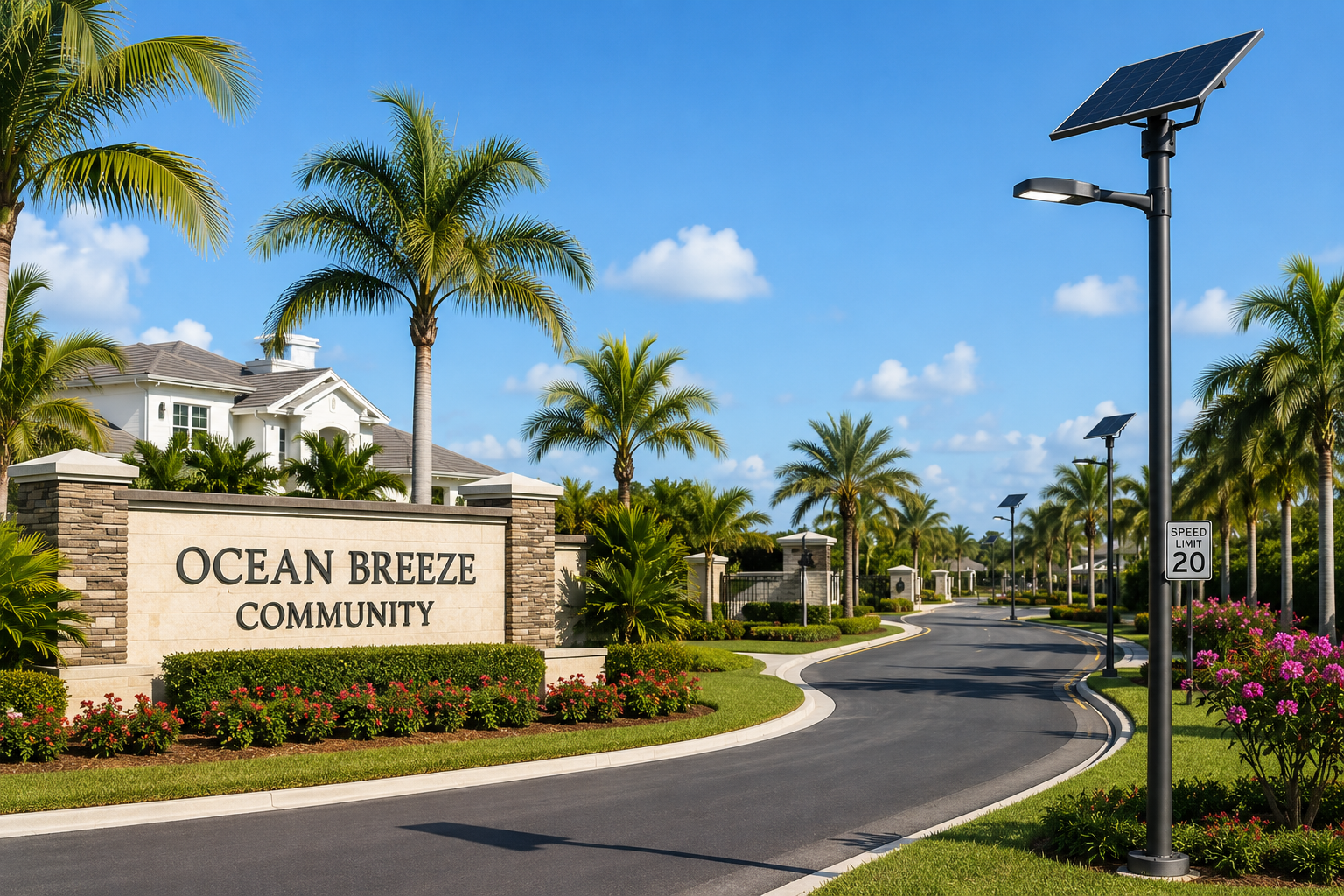
HOAs in hurricane-prone counties
are increasingly specifying solar lighting during redevelopment or storm-recovery upgrades, since it removes one more system dependent on grid restoration timelines that can stretch for days or weeks after a major storm.
Resort and hospitality developments
along the coast use solar pathway and parking lot lighting both for the sustainability story guests respond to and for the practical resilience of keeping grounds lit through storm season without a generator dependency.
Municipal and county projects
— particularly along evacuation corridors and public parking areas near beaches — increasingly favor solar for the same operational reason: lighting infrastructure that survives the exact event it's most needed for.
Matching the System to Florida's Actual Conditions
Coastal/barrier island installations:
highest wind rating tier, full corrosion-resistant hardware package, sealed battery housing.
Inland Florida installations:
standard hurricane-rated hardware is usually sufficient, with more flexibility on lumen tier selection based on road/parking classification.
HOA entries and pathway lighting:
lower lumen output is typically adequate, but hurricane-rated mounting shouldn't be skipped just because the fixture is smaller.
Highways, large lots, and commercial sites:
higher lumen tiers (14,800-22,000+ lumen class) with expansion panel options for extended cloudy-week autonomy during storm season's frequent overcast stretches.
FAQ: Florida Solar Street Lighting
Systems built with wind-rated poles, reinforced mounting, and marine-grade hardware are engineered specifically for this — but the rating needs to be confirmed per product, since "solar" alone doesn't guarantee wind resistance.
Well-designed systems carry 3-5+ days of battery autonomy, and expansion panel options exist for sites that need extra buffer during Florida's frequent overcast periods.
Beyond the standard utility-cost savings, Florida adds an extra layer: solar lighting doesn't go dark during storm-related outages, avoiding the safety and liability costs tied to unlit HOA and commercial properties post-storm.
Salt air travels further inland than most people expect in Florida — corrosion-resistant hardware is worth prioritizing for most of the state, not just barrier islands.
The Bottom Line
Florida's solar lighting story isn't really about sunshine — it's about resilience. A system that keeps working when the grid doesn't is worth more to a Florida HOA, resort, or municipality than the electricity savings alone, and that's exactly why hurricane-resistant solar street lighting has moved from "nice upgrade" to "standard spec" across the state.