
Texas Solar Street Lighting: What Developers and Municipalities Need to Know Before They Build
Texas has some of the best solar economics in the country. Here's how developers, HOAs, and municipalities are using off-grid solar street lighting to cut costs and build faster.
The Trenching Problem Nobody Budgets For
Every developer who has run utility power to a new subdivision knows the real cost of a streetlight isn't the fixture — it's everything underground. Trenching, conduit, transformer coordination, and utility interconnection scheduling can add weeks (sometimes months) to a project timeline and thousands of dollars per pole before a single light turns on.
Solar removes that entire category of cost and delay. A solar street light installs on a footing, gets bolted to a pole, and starts working the same day — no trench, no utility coordination meeting, no waiting on a transformer upgrade that's backlogged three months out.
For large residential developments, this isn't a minor convenience. It's often the difference between hitting a certificate-of-occupancy deadline and missing one.
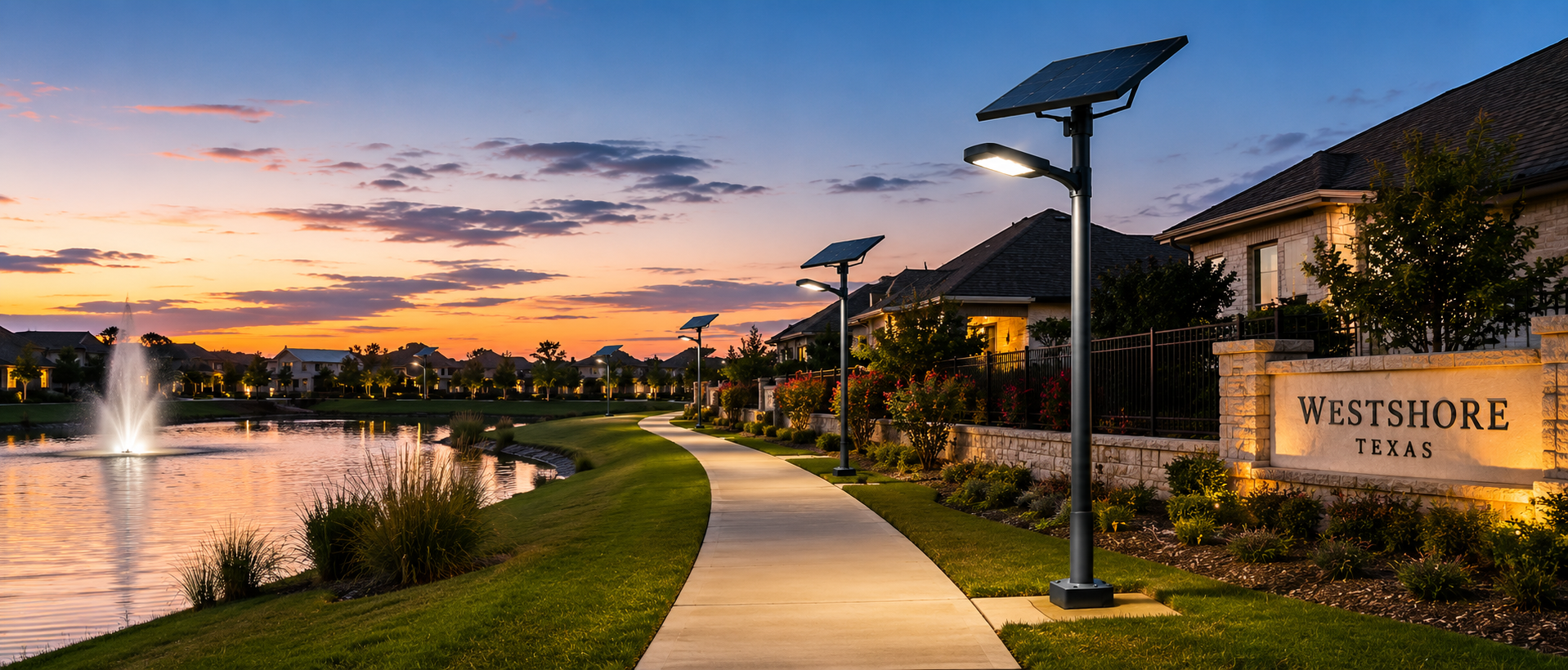
Why Texas Specifically Works So Well
High, consistent solar irradiance
across most of the state, particularly West and Central Texas, meaning smaller panel/battery combinations can still deliver reliable nightly output.
Land availability that favors sprawling, low-density development
— exactly the layout where trenching costs scale the fastest and solar's per-pole savings compound.
A grid that has shown real reliability strain
from summer demand peaks to winter freeze events. Off-grid lighting simply isn't affected by ERCOT-level grid stress, which is a real selling point for municipalities that remember February 2021.
Who's Actually Buying: Developers, HOAs, and Manufactured Home Communities
The Texas buyer base splits into a few clear groups, each with a different reason for going solar:
Residential developers
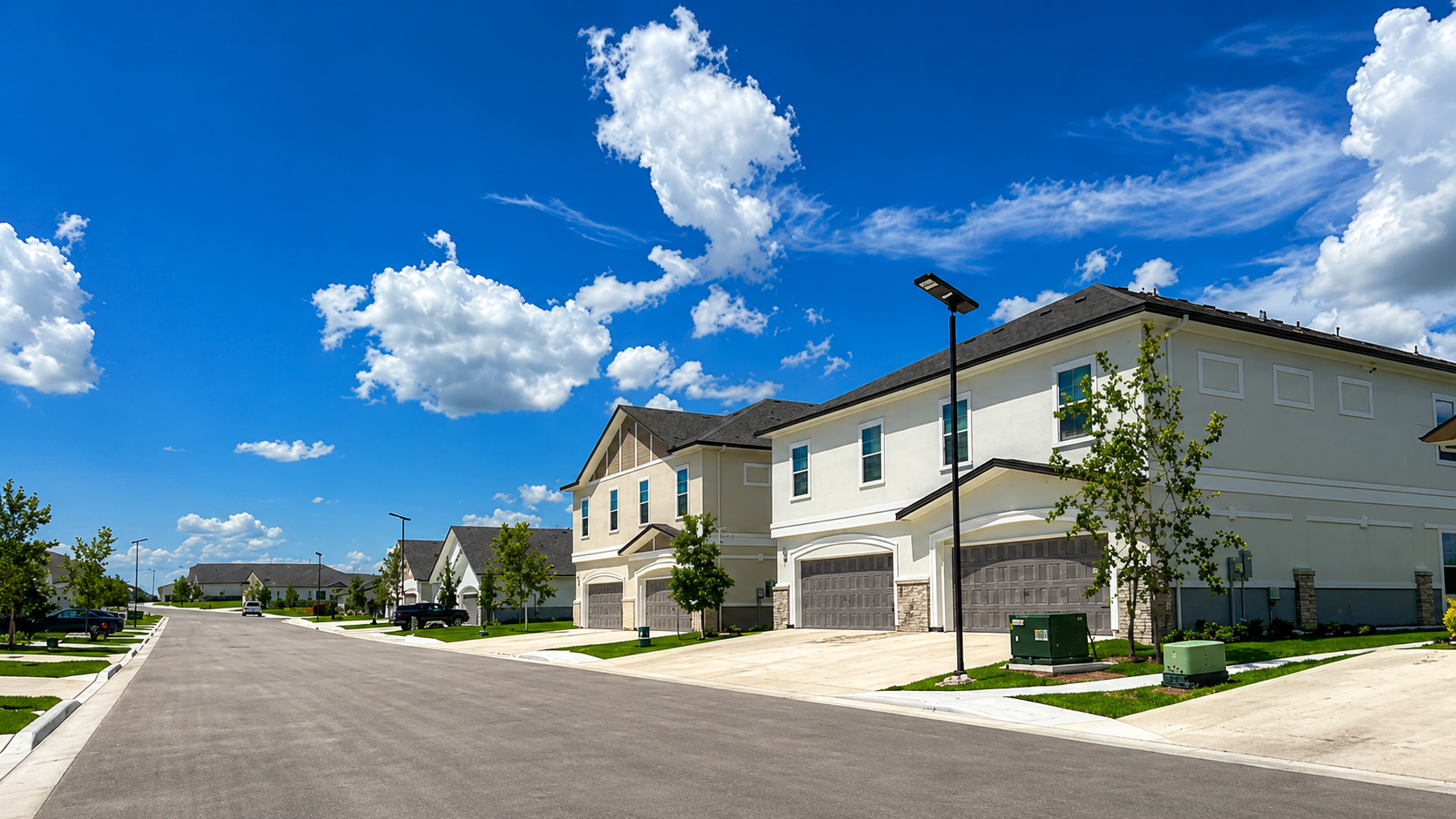
building new subdivisions in fast-growing metro-adjacent areas (Dallas-Fort Worth, Austin, San Antonio exurbs) use solar lighting to avoid utility coordination delays entirely, often lighting a development well before permanent grid power is even routed to the site.
HOAs with aging infrastructure
— many Texas neighborhoods are still running 30+ year old utility-owned fixtures, paying a rising monthly charge for lighting quality that hasn't improved since installation. Converting to owned solar fixtures turns that recurring cost into a fixed one-time investment.
Manufactured home and mobile home communities
have been early and consistent adopters, partly because retrofitting utility lighting across a large low-margin community is expensive, and partly because federal tax incentives on the solar equipment portion make the payback timeline attractive.
Specifying the Right System for Texas Conditions
Texas isn't one climate — a system spec'd for the Gulf Coast humidity and hurricane exposure of Houston or Corpus Christi should look different from one spec'd for the dry heat of El Paso or the Panhandle's wind load.
should prioritize wind-rated poles and hurricane-resistant fixture mounting, plus corrosion-resistant hardware for salt air exposure.
benefit most from the sheer sun availability — smaller battery banks can still deliver full nightly runtime, which can reduce system cost per pole.
benefit from monocrystalline panels with strong high-temperature performance, since panel efficiency drops in extreme heat unless the panel is specifically rated for it.
Lumen output should match road class, not just look impressive on a spec sheet: residential streets typically don't need highway-grade output, and over-specifying just adds unnecessary battery and panel cost per pole across a large development.
FAQ: Texas Solar Street Lighting
Yes, when spec'd correctly — monocrystalline panels and LiFePO4 batteries rated for high ambient temperature are essential; lower-grade components degrade faster in sustained 100°F+ conditions.
Look for wind-rated pole and mounting specifications and hurricane-resistant fixture design — this is a meaningfully different spec than a standard inland installation.
Yes — this is one of the biggest practical advantages for developers, since it decouples lighting timelines from utility interconnection scheduling entirely.
Per-pole trenching and utility interconnection costs in Texas can be substantial depending on distance and terrain; solar eliminates that cost category, which is usually where the real savings show up versus the fixture cost alone.
The Bottom Line
Texas' combination of sun, space, and grid strain has made solar street lighting less of an environmental choice and more of a straightforward infrastructure decision. Developers get faster timelines, HOAs get predictable long-term costs, and municipalities get lighting that doesn't go dark when the grid is under stress.